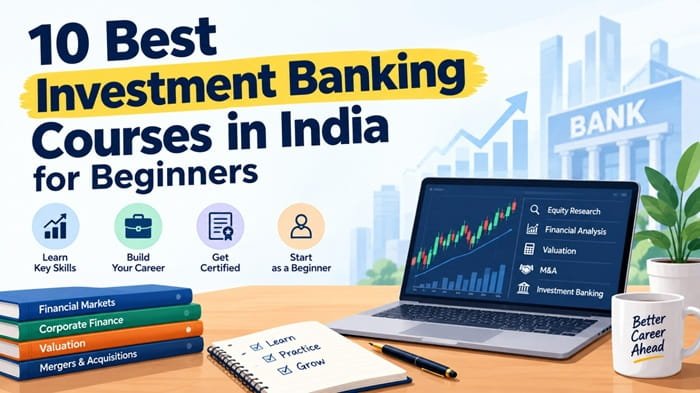
Investment banking still draws some of the most competitive job offers in Indian finance, but breaking in without a finance degree or a campus placement isn’t easy. A course won’t guarantee a job on its own, but the right one teaches the skills recruiters actually test for: valuation, financial modeling, and how deals really get done. Here are ten worth considering, from free primers to full live programs.
1. NISM’s Certification Programs
Before anything else, look at NISM, the National Institute of Securities Markets, set up by SEBI, India’s securities regulator. Its Series IX (Merchant Banking) and Series XII (Securities Markets Foundation) exams are affordable, government-recognized, and built specifically around IPOs, due diligence, and corporate advisory core investment banking work. They won’t teach you financial modeling, but they’re the fastest way to get a credential Indian BFSI recruiters already recognize.
2. Intellipaat’s Investment Banking Course – IIM Ranchi
If you want a full, live program instead of an exam-based certificate, Intellipaat’s Investment Banking Course from IIM Ranchi is built around nine modules: capital markets, equity and business valuation, fixed income, portfolio diversification, and more, taught by IIM Ranchi faculty over 120+ hours of live weekend classes, with a 3-day campus immersion included. It runs for 11 months and ends with an Executive PG Certification, backed by career support and access to Intellipaat’s hiring-partner network once you clear the placement readiness process.
3. NSE Academy’s Investment Banking Operations Certification
Run by NAL Academy (formerly NSE Academy), the exchange’s training arm, this certification focuses on the back office: trade life cycle, risk management, and regulation, rather than front-office deal-making. A solid, credible pick if you’re aiming for investment banking operations roles rather than research or advisory.
4. Yale’s Financial Markets (Coursera)
Robert Shiller’s Financial Markets course, free to audit on Coursera, isn’t an investment banking course by itself, but one full module is dedicated to underwriting, brokers, dealers, and exchanges. A genuinely useful primer if you want to understand how markets actually work before committing to a paid program.
5. CFA Program (CFA Institute)
The CFA charter isn’t a beginner course, but it’s worth knowing about early, since many investment bankers eventually pursue it. It’s a three-level, self-study program built around investment analysis, valuation, and portfolio management, and it carries more weight globally than almost any other finance credential. Most beginners pair it with a practical course rather than starting here.
6. New York Institute of Finance’s Introduction to Investment Banking (edX)
NYIF has trained Wall Street professionals for decades, and its Introduction to Investment Banking program on edX is a direct, no-frills way to learn the field from that lineage capital raising, M&A, and how deals move through a bank. Self-paced and university-platform hosted, so it’s easy to fit around a job.
7. BSE Institute Ltd’s Certificate Program on Investment Banking
BSE Institute is the Bombay Stock Exchange’s training subsidiary, and its investment banking certificate is short and dense financial modeling, valuation, M&A, and IPOs, taught by industry faculty. A good option if you want something exchange-backed but faster than a multi-month program.
8. IIBF’s Diploma in Treasury, Investment & Risk Management
The Indian Institute of Banking & Finance mainly trains bank employees, but its Diploma in Treasury, Investment & Risk Management is relevant if you’re coming from a banking background and want a recognized diploma rather than a short certificate. Delivered through distance learning, so it suits working professionals more than full-time students.
9. NPTEL’s Security Analysis and Portfolio Management
As academic as it gets: a free, IIT-taught course on SWAYAM covering valuation theory, technical analysis, and portfolio construction, with an optional proctored exam for those who want the certificate. It won’t teach you deal-making, but it builds the theoretical base a lot of practical courses skip over.
10. Khan Academy’s Finance and Capital Markets
For absolute beginners, Khan Academy’s free Finance and Capital Markets series explains stocks, bonds, IPOs, and interest rates in plain language with no jargon. There’s no certificate at the end, but if terms like “underwriting” or “yield curve” are still unfamiliar, this is where to start before anything else on this list.
Conclusion
None of these will hand you a career on their own; the syllabus and the project work behind it matter far more than the institution’s name on the certificate. If you are starting from zero, spend a few weeks with the free resources first: Khan Academy, Yale’s Financial Markets, and NISM’s foundation-level exam. Once the basics feel familiar, a longer, structured program Intellipaat’s Investment Banking Course, an NSE Academy or BSE Institute certificate, or a diploma from IIBF is what turns that vocabulary into an actual, interview-ready skill set.
FAQs
Do I need a finance degree to get into investment banking?
No. Several courses here, including Intellipaat’s program and NSE Academy’s certification, are designed for career switchers without a finance background. What matters more is whether you can demonstrate skills like financial modeling and valuation, which most beginner courses teach from scratch.
Which of these courses is best for someone with zero finance knowledge?
Start with something free, like Khan Academy’s Finance and Capital Markets series or Yale’s Financial Markets course on Coursera. Once the basic vocabulary makes sense, a structured program like Intellipaat’s Investment Banking Course adds the depth and hands-on modeling work that free resources don’t cover.
Is NISM certification mandatory for investment banking jobs in India?
It depends on the role. Certifications like NISM Series IX (Merchant Banking) are mandatory for certain SEBI-regulated roles, but not for every investment banking job. Even where it isn’t required, it’s a low-cost way to show recruiters you understand the regulatory side of the business.
How long does it typically take to become job-ready?
It varies by course and your starting point. Short certificates from BSE Institute or NSE Academy can be completed in a few weeks, while structured programs like Intellipaat’s IIM Ranchi course run closer to 11 months. Beginners with no finance background usually need the longer, more structured route to build a credible skill set.
Do these courses guarantee a job in investment banking?
No course can guarantee that, and it’s worth being skeptical of any that claim otherwise. A good course teaches the specific skills valuation, financial modeling, deal structuring that get you through the interview, and some, like Intellipaat’s program, add access to a hiring-partner network once you’re ready.