Appa Balwant Chowk, Pune: Facts, History & Connectivity
Appa Balwant Chowk — popularly known as A.B.C. — is one of the most iconic, historically significant, and culturally beloved intersections in Pune, Maharashtra, india. Located in the Shaniwar Peth and Budhwar Peth neighborhood of old Pune, at the heart of the city’s historic walled precinct, this celebrated chowk is best known as Pune’s most famous book market — a crowded, fragrant, and intellectually vibrant crossroads lined with bookshops, stalls, and street vendors selling everything from rare academic textbooks and competitive exam guides to classic Marathi literature and second-hand novels. Named after Sardar Appa Balwant Mehendale, a commander in the Maratha army who is said to have saved the Peshwa during a royal procession, the chowk holds centuries of history within its narrow lanes.
In 2026, Appa Balwant Chowk remains one of Pune’s most visited and cherished landmarks — a place that students, scholars, bibliophiles, and curious visitors have been drawn to for generations. It is not merely a book market but a living expression of Pune’s identity as the Oxford of the East — a city that has always placed education, knowledge, and intellectual life at its very heart. From the 15th century Tambdi Jogeshwari temple to the colonial-era architecture of surrounding wadas, and from the bustle of Laxmi Road to the solemnity of Shaniwarwada nearby, Appa Balwant Chowk sits at the crossroads of Pune’s past and present.
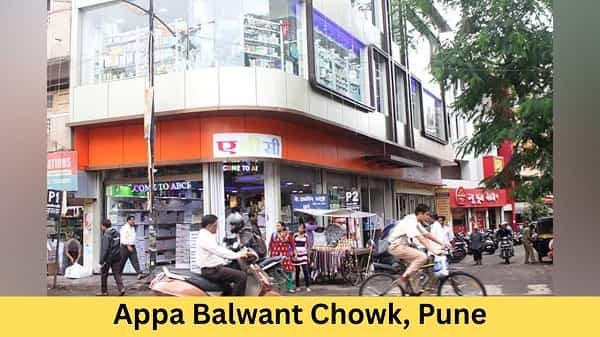
Appa Balwant Chowk Pune Quick Details
| Category | Details |
| Location | Appa Balwant Chowk, Budhwar Peth / Shaniwar Peth, Pune – 411002 |
| Also Known As | ABC Pune; Pune Book Market; A.B.C. Chowk |
| Nearest City | Mumbai (~150 km), Nashik (~210 km) |
| Highway | Connected via NH-48 (Mumbai–Pune Expressway) and Old Mumbai–Pune Highway |
| Key Roads | NC Kelkar Road, Laxmi Road, Shaniwar Peth Road, Budhwar Peth Road, Bajirao Road |
| Nearest Railway Stn | Pune Junction Railway Station (~2 km) |
| Nearest Metro | Mandai Metro station – Pune Metro Purple Line (~15 min walk) |
| Nearest Airport | Pune International Airport (~13 km) |
| Bus Connectivity | PMPML buses (Routes 11A, 21, 2B, 8, 94 and more), autos, e-rickshaws |
| Iconic Landmark | Tambdi Jogeshwari Temple, Shaniwarwada, Mahatma Phule Mandai |
| Importance | Literary, cultural, religious, commercial & heritage hub |
| Nearby Areas | Shaniwar Peth, Budhwar Peth, Laxmi Road, Kasba Peth, Tulshibaug |
| Pin Code | 411002 |
| Admin Body | Pune Municipal Corporation (PMC) |
| Redevelopment Status | Heritage precinct conservation and PMC urban upgrades (ongoing) |
1. Location & Identity of Appa Balwant Chowk
Appa Balwant Chowk is located at the intersection of NC Kelkar Road and the surrounding lanes of Budhwar Peth and Shaniwar Peth — two of the oldest and most historically significant neighborhoods in Pune’s walled city. The chowk’s position connecting Shaniwar Peth, Budhwar Peth, and the famous Laxmi Road ensures it has always been at the geographic and social heart of old Pune, drawing traders, scholars, priests, and everyday residents alike for centuries. It is just a 5-minute walk from the iconic Shaniwarwada — the historic fortified palace of the Peshwas — reinforcing its place at the very center of Pune’s historical urban core.
The chowk’s most defining feature is its extraordinary concentration of bookshops. First established as a book market in the late 1950s following the opening of L. N. Godbole’s shop, A.B.C. grew steadily as Pune’s large student and academic population found in it an affordable and diverse source of books. Today dozens of shops, stalls, and street vendors crowd every available corner, creating what is widely celebrated as Pune’s open-air library — a place where a college student can find a competitive exam guide, a researcher can discover a rare Marathi text, and a casual reader can pick up a second-hand novel at a fraction of its cover price.
The identity of Appa Balwant Chowk is shaped by:
- Its fame as Pune’s most celebrated book market and the open-air library of the Oxford of the East
- Its deep historical roots — named after a Maratha army commander and home to a 15th century temple
- Its role as a cultural and intellectual gathering point for Pune’s enormous student and academic community
It is often described as:
- Pune’s open-air library — where knowledge is available on every street corner
- One of Maharashtra’s most beloved cultural and literary landmarks
The area is surrounded by:
- Bookshops, stationery stores, and educational supply vendors covering every inch of the chowk
- The 15th century Tambdi Jogeshwari temple — a revered religious landmark within the chowk
- Historic wadas with carved wooden balconies and colonial-era architecture
Administered by: Pune Municipal Corporation (PMC), responsible for civic maintenance and heritage conservation in this historically sensitive precinct of old Pune.
2. Connectivity & Transport Infrastructure
Appa Balwant Chowk is centrally located in Pune’s old city and benefits from strong public transport connectivity, though the narrow lanes of the heritage precinct make private vehicle access challenging and public transport the recommended choice.
1. Road Connectivity
NC Kelkar Road:
The road on which Appa Balwant Chowk is primarily situated, NC Kelkar Road connects the chowk to Laxmi Road — Pune’s most famous and busiest commercial street — and to the surrounding Shaniwar Peth and Budhwar Peth neighborhoods. This road is narrow and heavily congested with pedestrian and commercial traffic, particularly during peak market hours.
Laxmi Road:
One of Pune’s most iconic and historically important commercial roads, Laxmi Road runs adjacent to the A.B.C. zone and connects the chowk area to the city’s broader commercial network including Tulshibaug, Mandai, and the heart of the old city. Walking from Laxmi Road to A.B.C. is one of the classic Pune experiences.
Bajirao Road and Shaniwar Peth Road:
These historically significant roads connect Appa Balwant Chowk to the Shaniwarwada precinct, the Kasba area, and the broader Peth neighborhoods of old Pune, reinforcing the chowk’s position at the center of the city’s historic urban fabric.
Due to the heritage character of the surrounding lanes and the density of pedestrian activity, most visitors to A.B.C. are advised to use public transport or park at a distance and walk to the chowk.
2. Metro & Rail Connectivity
Mandai Metro Station — Pune Metro Purple Line:
The nearest metro station to Appa Balwant Chowk is Mandai on the Pune Metro Purple Line, approximately a 15-minute walk away. The Purple Line connects the A.B.C. zone to Pune Railway Station, Swargate, and the broader city, offering a clean and time-efficient alternative to road travel for visitors arriving from across Pune.
Pune Junction Railway Station:
Located approximately 2 km from A.B.C., Pune Junction is one of India’s busiest and most important railway stations, providing direct connectivity to Mumbai, Delhi, Bengaluru, Hyderabad, Nagpur, and virtually every major city in India. Its proximity makes Appa Balwant Chowk easily accessible to students and visitors arriving by train from across Maharashtra and beyond.
Pune International Airport:
Situated approximately 13 km from the chowk, Pune Airport connects the city to domestic and select international destinations, bringing tourists and business travelers to Pune who often include A.B.C. in their city itinerary.
3. Public Transport & Movement
- PMPML bus routes 11A, 143, 21, 219, 2B, 8, and 94 all serve the Appa Balwant Chowk area
- Auto-rickshaws are the most convenient and widely used mode of access to the chowk from across the city
- Walking is the best way to explore A.B.C. and the surrounding Peth neighborhood — most landmarks are within a 10-minute walk
- Parking is extremely limited; visitors are strongly advised to use public transport or park on nearby main roads
The chowk’s walkability is one of its defining assets — once you arrive, everything from Shaniwarwada to Mahatma Phule Mandai to Laxmi Road is accessible entirely on foot.
3. Historical Background & Cultural Significance
Appa Balwant Chowk is one of the most historically layered intersections in Pune — a place where centuries of Maratha history, colonial-era transformation, freedom struggle memory, and modern intellectual culture all coexist within a few crowded lanes.
Maratha Heritage & the Naming of the Chowk
The chowk is named after Sardar Appa Balwant Mehendale — a commander in the Maratha army during the Peshwa era. According to historical accounts, the young Appa Balwant once saved the Peshwa during a royal procession, an act of bravery that so impressed the ruler that he named the crossroad after him as a lasting tribute. This origin story connects the chowk directly to the Peshwa era of the 18th century, when Pune was the political capital of the Maratha Confederacy and Shaniwarwada — just steps away — was its seat of power. The chowk thus carries within its name a fragment of the most glorious chapter in Marathi history.
The Freedom Struggle at A.B.C.
On August 9, 1942 — the day the Quit India Movement was launched by Mahatma Gandhi — a defining moment of courage took place at Appa Balwant Chowk. A teenage boy defiantly raised the Indian national flag at the chowk in protest of British rule. British police opened fire, killing two people. This act of sacrifice triggered a wave of anti-colonial protests across Pune, including a theatre bombing. The 75th anniversary of this event was solemnly commemorated in 2018, reminding Pune of the blood spilled for freedom at this very crossroad. A.B.C. is thus not just a book market but a site of national historical memory.
Tambdi Jogeshwari Temple
Standing at the heart of Appa Balwant Chowk is the Tambdi Jogeshwari temple — a 15th century Hindu shrine dedicated to Goddess Jogeshwari. One of Pune’s oldest temples, its red-painted sanctum (tambdi meaning red in Marathi) is a vivid and sacred presence amid the bustle of the book market. The temple draws daily devotees and adds a dimension of spiritual continuity to the chowk that stretches back over six centuries, predating even the Peshwa era.
Iconic Landmarks Nearby
- Tambdi Jogeshwari Temple — 15th century temple at the heart of the chowk
- Shaniwarwada — the magnificent Peshwa-era fortified palace, a 5-minute walk away
- Mahatma Phule Mandai — Pune’s iconic Victorian-era vegetable and wholesale market
- Vishram Baug Wada — a historic Peshwa-era mansion with ornate wooden carvings
- Laxmi Road — Pune’s most famous and vibrant commercial street
4. Commercial & Market Activity
Appa Balwant Chowk is Pune’s most celebrated literary marketplace and one of Maharashtra’s most famous street shopping destinations, known primarily for its extraordinary concentration of bookshops but also hosting a diverse range of trade.
The Book Market — A.B.C.’s Defining Identity
The book market at Appa Balwant Chowk is the heart and soul of the chowk’s commercial identity. What began with L. N. Godbole’s pioneering bookshop in the late 1950s has grown into one of India’s most famous street book markets, with dozens of shops and stalls lining every available surface:
- Academic and competitive exam books — UPSC, MPSC, banking, engineering, and medical entrance preparation material
- Second-hand and used books at bargain prices — from classic Indian literature to international bestsellers
- Rare Marathi literature, regional language books, and out-of-print titles
- Stationery, art supplies, and educational materials for students of all levels
Other Commercial Activity
- Fabric and garment shops in surrounding Budhwar Peth lanes
- Jewellery and accessories from the Tulshibaug and Laxmi Road commercial zone
- Religious goods, flowers, and prasad catering to the Tambdi Jogeshwari temple visitors
- Mobile accessories, electronics, and repair stalls serving daily needs
The area attracts:
- Students from Pune’s dozens of colleges and universities seeking affordable textbooks
- Competitive exam aspirants hunting for study material and previous year papers
- Bibliophiles and collectors seeking rare, second-hand, and out-of-print books
Street Food & Dining
The lanes around A.B.C. offer authentic Punekar street food experiences:
- Misal pav and vada pav — Pune’s most iconic street food at famous nearby stalls
- Sabudana khichdi, poha, and thalipeeth — traditional Maharashtrian breakfast staples
- Tulshibaug sweet shops and chaat stalls — a legacy of old Pune’s culinary traditions
The food culture around A.B.C. is deeply Punekar — simple, authentic, and reflective of a neighborhood that has fed generations of students and scholars.
5. Cultural & Academic Importance (2026)
Appa Balwant Chowk’s importance goes far beyond commerce — it is a cultural institution that reflects and reinforces Pune’s identity as Maharashtra’s intellectual capital and the Oxford of the East.
Pune’s Identity as the Oxford of the East
- Pune hosts some of India’s most prestigious educational institutions including Savitribai Phule Pune University, FTII, IISER, NCL, and dozens of leading colleges
- B.C. serves as the informal book supply hub for this enormous student and academic population
- The chowk has launched countless academic careers by making quality education materials accessible at affordable prices
Literary & Intellectual Significance
- B.C. is celebrated as Pune’s open-air library — a democratic space where knowledge is accessible to all regardless of income
- The chowk regularly features in travel writing, food and culture journalism, and academic discussions about Pune’s unique character
- Its juxtaposition of 15th century temple, Peshwa-era streets, colonial architecture, and modern student culture makes it one of India’s most layered urban spaces
It is ideal for:
- Students and academics seeking the most affordable and comprehensive book market in Pune
- Heritage and culture tourists exploring Pune’s extraordinary Peshwa-era old city
- Visitors wanting an authentic, non-touristy Pune experience rooted in the city’s intellectual soul
6. Social Infrastructure & Daily Life
Appa Balwant Chowk and the surrounding Peth neighborhoods are supported by Pune’s extensive civic infrastructure, serving the old city’s large residential and commercial population.
1. Education
- Proximity to Savitribai Phule Pune University and dozens of affiliated colleges across the city
- Several historical schools and educational institutions in the surrounding Peth neighborhoods
- The chowk itself functions as an informal educational resource center for Pune’s student community
2. Healthcare
- Sassoon General Hospital — Pune’s principal government hospital — accessible from the old city area
- Multiple clinics, dispensaries, and private hospitals serving the Peth residential zones
- Pharmacies and health services available within the surrounding neighborhood
3. Shopping & Lifestyle
- Laxmi Road and Tulshibaug offering Pune’s most traditional and beloved shopping experience
- Mahatma Phule Mandai providing fresh produce and the authentic flavours of old Pune
- Shaniwarwada, Vishram Baug Wada, and Kasba Ganpati Temple enriching the area’s cultural life
- The entire old city Peth zone walkable and explorable on foot — one of Pune’s finest urban experiences
7. Heritage Conservation & Urban Changes
Appa Balwant Chowk and the surrounding Peth neighborhoods represent one of Maharashtra’s most important heritage urban precincts, and Pune Municipal Corporation has undertaken several conservation and improvement initiatives to protect and enhance this irreplaceable zone.
Key Initiatives
- PMC heritage conservation programs protecting the wadas, temples, and colonial-era structures of the Peth neighborhoods
- Pedestrianization and traffic management improvements to ease congestion in the narrow heritage lanes
- Pune Metro Purple Line bringing improved city-wide connectivity to the old city zone via Mandai station
- Improved street lighting, drainage, and waste management in the heritage precinct
Challenges & Preservation
- Balancing commercial pressure from expanding market activity with heritage conservation of the surrounding wadas
- Managing the enormous pedestrian footfall that the book market and temple attract on a daily basis
- Preserving the authentic character of the book market amid rising real estate values in central Pune
This conservation effort has helped balance:
The living, breathing commercial energy of A.B.C. + the heritage architectural and cultural fabric of old Pune
Conclusion
Appa Balwant Chowk in Pune is far more than a book market or a road intersection — it is one of India’s most remarkable urban spaces, where a 15th century temple, Peshwa-era history, a freedom struggle memory, centuries of Maharashtrian culture, and the intellectual ambitions of generations of Pune students all coexist within a few wonderfully crowded lanes.
In 2026, A.B.C. stands as enduring proof that a city’s true character lives not in its newest towers but in its oldest crossroads. With the Tambdi Jogeshwari temple marking its spiritual anchor, Shaniwarwada as its historical backdrop, Laxmi Road as its commercial lifeline, and thousands of books lining every wall and shelf, Appa Balwant Chowk remains one of Pune’s most loved, most visited, and most irreplaceable landmarks.
Whether you are a student hunting for an affordable competitive exam guide, a bibliophile seeking a rare Marathi title, a heritage traveller exploring the lanes of Peshwa-era Pune, a foodie stopping for misal pav at a nearby stall, or simply a lover of cities who wants to experience the authentic, unscripted soul of the Oxford of the East, Appa Balwant Chowk offers an experience that is uniquely, beautifully, and completely Pune.