 11
11At the pulsing heart of Srinagar — the summer capital of Jammu & Kashmir — sits a square that has borne witness to the arc of Kashmir’s modern history more intimately than any other address in the valley. Lal Chowk, meaning ‘Red Square’ in Urdu, is positioned at the intersection of Residency Road and MA Road in central Srinagar, and has served as the city’s primary commercial hub, political stage, and cultural crossroads for well over a century. The name traces its origins to the socialist and leftist influences of the 1940s — when Kashmiri political movements drew inspiration from international left ideology and named the square after Moscow’s iconic Red Square. At its centre stands the Ghanta Ghar — the clock tower built by Bajaj Electricals in 1979–80 at the request of then-Chief Minister Sheikh Mohammad Abdullah — which has since become Srinagar’s most photographed and most politically significant landmark.
In 2026, Lal Chowk presents a strikingly different face from a decade ago. Following the abrogation of Article 370 on August 5, 2019, and Jammu & Kashmir’s reorganisation into a Union Territory, the area has seen accelerated infrastructure investment under the Srinagar Smart City Project. By February 2025, the Smart City redevelopment of Lal Chowk was fully completed — bringing LED street lighting, a dedicated cycle track, widened footpaths, smart vending zones, green treelines, and a beautifully renovated and illuminated Ghanta Ghar. Jammu & Kashmir tourism has surpassed 7.6 crore visitors since 2019, and Lal Chowk is firmly among Srinagar’s top attractions — a living heritage square that is simultaneously a bustling commercial district, a tourist landmark, a street food haven, and an open-air gallery of Kashmir’s extraordinary story.
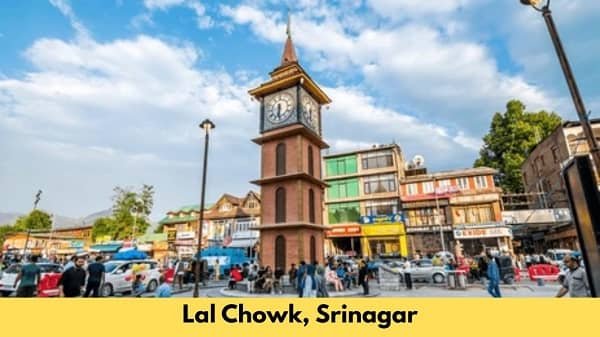
A comprehensive at-a-glance reference covering the most important details about Lal Chowk, Srinagar — fully updated for 2026.
| Key Detail | Information (2026) |
| 📍 Location | Residency Road × MA Road, Lal Chowk, Srinagar, J&K – 190001 |
| 🏙️ Status | Summer Capital of Jammu & Kashmir (Union Territory of India since Oct 31, 2019) |
| 🏛️ Meaning of Name | Lal Chowk = ‘Red Square’ in Urdu — inspired by socialist ideology of the 1940s |
| ⏰ Iconic Landmark | Ghanta Ghar (Clock Tower) — built by Bajaj Electricals, 1979–80, at request of Sheikh Mohammad Abdullah |
| 🔄 Smart City Renovation | Ghanta Ghar renovated & beautified under Srinagar Smart City Project; redevelopment fully completed by Feb 2025 |
| 💡 New 2023–25 Features | LED street lighting, cycle track (since 2023), widened footpaths, green tree lines, smart vending zones, improved drainage |
| 🛣️ Key Roads | Residency Road | MA Road | Polo View Road | Lal Chowk–Amira Kadal stretch (Jhelum River bridge, ~1 km) |
| 🕐 Best Visiting Hours | 10 AM – 7 PM (shops & markets) | Evenings best for illuminated Ghanta Ghar & street food |
| 📅 Market Off Day | Fridays — many shops remain closed for Jumma prayers |
| 🚗 Road Connectivity | NH-44 (Srinagar–Jammu) | NH-1 (Srinagar–Leh) | Srinagar Ring Road | JKRTC & private buses |
| ✈️ Airport | Sheikh ul-Alam International Airport — ~12 km (~25–30 min by taxi/cab) |
| 🚉 Nearest Rail | Banihal Railway Station — ~70 km (USBRL Project; Srinagar railway station under construction) |
| 🚌 Local Transport | City buses (SRTC), shared auto-rickshaws, cycle-rickshaws, Ola/Uber cabs |
| 🛍️ Famous Products | Pashmina shawls, Kashmiri carpets, papier-mâché, saffron, walnuts, dry fruits, silver jewellery, Kahwa spices |
| 🍽️ Street Food Highlights | Wazwan delicacies, Kahwa (saffron tea), Noon Chai (pink salt tea), Kashmiri bakeries, seekh kababs |
| 🏛️ Adjacent Markets | Koker Bazar | Maharaja Bazar | Polo View Market | Hari Singh High Street | Residency Road shops |
| 🌟 Tourism Status | J&K tourism crossed 7.6 crore visitors since 2019 | Lal Chowk among top Srinagar attractions |
| 🏟️ Nearby Landmark | Bakshi Stadium (Republic Day & Independence Day flag ceremonies) — ~1 km |
| 🎭 Cultural Events 2025–26 | Diwali illuminations, Independence Day lighting, BJP-led cultural exhibitions (Sept 22, 2025); Lal Chowk increasingly used for national festivals |
Lal Chowk’s history as a prominent public space predates its current name. Before the construction of the clock tower, the site featured a ‘Red Square’ developed during the British colonial period — a simple open plaza along the main commercial street of Srinagar. The precinct stretches along both sides of Residency Road between the Amira Kadal bridge over the Jhelum River and the Tyndale Biscoe School, and evolved into Srinagar’s primary business district through the early twentieth century.
The square’s modern political chapter began after Indian independence. Jawaharlal Nehru, India’s first Prime Minister, unfurled the national flag at Lal Chowk in 1948 — an act that carried deep symbolic weight for Kashmir’s accession to India. Through the insurgency years of the late 1980s and 1990s, the chowk became a stage for some of Kashmir’s most charged political moments. In 1992, then-BJP president Murli Manohar Joshi hoisted the Indian tricolour atop the Ghanta Ghar on Republic Day, accompanied by Indian troops — an act that became one of the decade’s defining political images.
The 1993 arson attack on the main commercial centre of Downtown Srinagar left significant destruction in its wake. Through the following decades, Lal Chowk oscillated between commerce and conflict, resilience and unrest — a square that refused to be reduced to either. Since 2019, cultural and national festivals have transformed the tone of Lal Chowk entirely: Diwali illuminations, Independence Day lighting displays, and cultural exhibitions like the BJP-led programme held on September 22, 2025 have become the new associations with this address. The beautifully lit Ghanta Ghar — now a nightly spectacle visible from across the square — has become the defining image of Srinagar’s new chapter of normalcy and tourism growth.
The Srinagar Smart City Project — launched following the administrative changes of 2019 — identified Lal Chowk as a priority zone for heritage-sensitive urban redevelopment. By February 2025, all Smart City work at Lal Chowk was fully completed, making it one of 143 of 161 projects completed across Srinagar under this programme. The key upgrades delivered include:
The Sheikh ul-Alam International Airport, Srinagar is approximately 12 km from Lal Chowk — a 25–30 minute journey by taxi or cab under normal traffic conditions. The airport handles domestic flights to Delhi, Mumbai, Bengaluru, Jammu, Leh, and other major Indian cities, as well as some international charters. App-based cab services (Ola, Uber) and prepaid taxi counters are available at the airport terminal for direct rides to Lal Chowk. Following J&K’s tourism surge since 2019, the airport’s infrastructure and capacity have been progressively expanded to handle growing passenger volumes.
Lal Chowk is centrally located and accessible from all parts of Srinagar by road. NH-44 (Srinagar–Jammu National Highway) connects the city to Jammu (~300 km, approximately 6–7 hours by road), and onward to the rest of India’s road network. NH-1 (Srinagar–Leh Highway) heads northeast toward Ladakh — open seasonally. The Srinagar Ring Road allows bypass access around the city for those approaching from Jammu or the airport. Within the city, SRTC city buses, shared auto-rickshaws, and cycle-rickshaws provide affordable last-mile access to Lal Chowk from all parts of Srinagar. App-based cabs (Ola, Uber) and traditional Srinagar taxis are widely available at and around the square.
The Udhampur–Srinagar–Baramulla Rail Link (USBRL) — one of India’s most ambitious infrastructure projects — is the railway connection to the Kashmir Valley. As of 2026, the nearest operational railway station remains Banihal (~70 km from Srinagar), from where taxis and JKRTC buses ferry passengers to the city in approximately 2 hours. The critical Banihal–Khari–Sumber–Sangaldan section of the USBRL — which will eventually connect Srinagar directly to the national rail network via the Chenab Bridge (world’s highest railway bridge) — is in its final construction stages. When completed, this will bring rail connectivity directly to Srinagar city, transforming access to Lal Chowk from the rest of India.
Lal Chowk is Srinagar’s premier retail and wholesale hub — a living bazaar where nearly every product carries a Kashmir story. Shops specialise in Pashmina shawls, Kashmiri handmade carpets, papier-mâché artefacts, Kashmiri saffron (among the world’s finest), walnuts, almonds, apricots, silver jewellery, and traditional Kashmiri spices and Kahwa tea blends. The adjacent lanes fan outward into several distinct market zones, each with its own commercial identity.
| Market / Bazaar | Speciality | Best For |
| Lal Chowk Main Street | General retail, handicrafts, Kashmiri souvenirs | First-time visitors & everything Kashmiri |
| Koker Bazar | Handicrafts, daily essentials, local produce | Authentic local shopping experience |
| Polo View Market | Branded goods, electronics, fine handicrafts | Premium shopping & upscale cafes |
| Maharaja Bazar | Traditional Kashmiri goods, shawls, carpets | Wholesale & retail Pashmina & woollens |
| Hari Singh High Street | Clothing, jewellery, stationery | Everyday retail needs |
| Residency Road Shops | Saffron, dry fruits, spices, silver jewellery | Authentic J&K products & spices |
| Khanqah Bazaar (nearby) | Street food, local bakeries, Kahwa | Food walk & traditional Kashmiri cuisine |
Bargaining is accepted and expected at most market stalls and smaller shops. Fixed-price establishments exist at Polo View Market and select branded stores on Residency Road. Fridays are a weekly off-day for many shops due to Jumma prayers — plan accordingly. The best time to shop is between 10 AM and 6 PM on weekdays, when vendors are fully stocked and the market is at its most vibrant.
No visit to Lal Chowk is complete without experiencing Kashmiri cuisine — one of India’s most distinct and celebrated culinary traditions. The streets and lanes around the square offer authentic experiences that no restaurant menu can fully replicate. Kahwa — the traditional Kashmiri saffron, cardamom, cinnamon, and almond tea — is the signature drink of the valley and sold at almost every chai stall around the chowk. Noon Chai (pink Kashmiri salt tea with milk) is another must-try that visitors often find fascinatingly unique.
The Wazwan — a ceremonial Kashmiri multi-course feast featuring Rogan Josh, Gushtaba, Yakhni, and Tabak Maaz — is available at several restaurants within walking distance of Lal Chowk. Street-side seekh kababs, shami kababs, and Kashmiri bakery breads (Lavasa, Czot, Sheermal) from the neighbourhood bakeries are popular quick bites. Kashmiri dry fruit sellers along Residency Road offer fresh seasonal walnuts, saffron-mixed almonds, and premium dried apricots — all excellent souvenirs and edible gifts for travellers.
Lal Chowk’s central location in Srinagar places it within easy reach of the valley’s most iconic heritage sites, Mughal gardens, and natural landmarks. The following table covers key attractions with distances from Lal Chowk.
| Attraction | Distance | Highlights |
| Dal Lake | ~5 km | Shikara rides, houseboats, floating markets; Srinagar’s crown jewel |
| Bakshi Stadium | ~1 km | Republic Day & Independence Day ceremonies; 75,000 capacity |
| Hari Parbat Fort | ~6.5 km | 18th-century Afghan fort; panoramic view of Dal Lake & Srinagar |
| Shankaracharya Temple | ~6 km | Ancient Shiva temple atop Shankaracharya Hill (1,100 m altitude) |
| Shalimar Bagh (Mughal Garden) | ~15 km | Famous terraced Mughal garden on Dal Lake shoreline |
| Nishat Bagh (Mughal Garden) | ~12 km | ‘Garden of Bliss’; 12-terraced Mughal garden by Dal Lake |
| Pari Mahal | ~10 km | 7-terraced Islamic garden on Zabarwan Hill; Dal Lake views |
| Jama Masjid (Nowhatta) | ~2 km | 14th-century mosque; largest in Kashmir; 378 wooden pillars |
| Hazratbal Shrine | ~8 km | Revered Sufi shrine housing relic of Prophet Muhammad (PBUH) |
| Chashma Shahi (Royal Spring) | ~14 km | Mughal garden built 1632 AD; natural spring garden |
| Badamwari (Almond Garden) | ~5 km | Historic almond grove; spectacular spring blossom season (Feb–Mar) |
| Indira Gandhi Memorial Tulip Garden | ~9 km | Asia’s largest tulip garden; ~15 lakh blooms (March–April season) |
Q1. What is Lal Chowk famous for?
Lal Chowk is famous for three things: its iconic Ghanta Ghar (clock tower), built in 1979–80 and recently renovated under the Srinagar Smart City Project; its role as Srinagar’s premier commercial hub specialising in Kashmiri handicrafts, Pashmina, saffron, dry fruits, and carpets; and its deep political history as the square where Jawaharlal Nehru hoisted the Indian flag in 1948 and where successive generations of politicians and activists have gathered for landmark moments in Kashmir’s modern history.
Q2. What does ‘Lal Chowk’ mean?
Lal Chowk means ‘Red Square’ in Urdu. The name was inspired by the socialist and leftist political movements of 1940s Kashmir, drawing a deliberate parallel with Moscow’s Red Square — reflecting the ideological leanings of Kashmiri political organisations of that era. The name has endured through all political changes since, remaining the universally used designation for this central Srinagar square.
Q3. What are the Smart City upgrades done at Lal Chowk?
Under the Srinagar Smart City Project — fully completed at Lal Chowk by February 2025 — the key upgrades include: full renovation and LED illumination of the Ghanta Ghar clock tower; introduction of a dedicated cycle track (since 2023); LED street lighting across all surrounding roads; widened footpaths; green treelines along access roads; smart vending zones for organised street hawking; and drainage retrofitting for monsoon resilience. These upgrades are part of 143 of 161 Smart City projects completed across Srinagar.
Q4. How do I reach Lal Chowk from Srinagar Airport?
Sheikh ul-Alam International Airport is approximately 12 km from Lal Chowk — roughly 25–30 minutes by taxi or app-based cab (Ola/Uber) under normal traffic. Prepaid taxi counters at the airport provide fixed-rate rides to central Srinagar. There is no direct metro or rail link currently; road transport is the primary mode. In 2026, the USBRL railway project is still completing its Srinagar connection — the nearest rail station remains Banihal, approximately 70 km away.
Q5. Is Lal Chowk safe to visit in 2026?
Yes — Lal Chowk is safe for visitors in 2026. Since the administrative changes of 2019 and the Smart City redevelopment completed in 2025, Lal Chowk has seen dramatically increased tourist footfall, including large numbers of domestic tourists and international visitors. Cultural events, national festivals, and evening illumination programmes are regularly held here. A visible security presence, CCTV surveillance, and improved public infrastructure have made the area more welcoming and secure than at any time in recent decades. Standard urban safety precautions apply.
Q6. What are the best things to buy at Lal Chowk?
The best Kashmiri products to buy at Lal Chowk and surrounding markets include: Pashmina shawls (verify purity from certified sellers), handmade Kashmiri carpets (Persian-influenced knotted wool and silk), papier-mâché artefacts (painted boxes, bowls, and decorative items), Kashmiri saffron (buy from reputed sellers on Residency Road with proper packaging and certification), walnuts, dried apricots and almonds, silver jewellery, and authentic Kashmiri Kahwa spice mixes. Polo View Market and Residency Road shops offer a more curated, fixed-price alternative to the bargaining lanes of Koker Bazar and Maharaja Bazar.
Lal Chowk in 2026 is a square that has fully reclaimed its identity as the living heart of Srinagar — and, by extension, of Kashmir’s public life. The Ghanta Ghar stands renovated, illuminated, and celebrated. The markets bustle with tourists from across India and beyond. The Srinagar Smart City Project has delivered a cleaner, better-lit, more navigable public space without erasing the layers of history etched into every stone.
Whether you come as a first-time tourist marvelling at the clock tower under evening lights, a history enthusiast tracing the political events that have played out on this square for over seven decades, a foodie chasing Kahwa and Wazwan flavours, or a shopper hunting for authentic Pashmina and saffron — Lal Chowk offers an experience that is uniquely, irreducibly Kashmiri. It is an address that has survived every storm the valley has seen, and in 2026 stands ready to welcome the world.